

March 09, 2026
Oil Prices Spike Amid Middle East Tensions
In light of recent events in the Middle East that caused a major spike in oil prices, the key question is how long these elevated prices will last. Geopolitical tensions often trigger immediate reactions in oil markets because the region accounts for a significant share of global oil production and export routes.
During the first week of March 2026, the escalation in the Middle East pushed all major crude benchmarks sharply higher. Brent averaged roughly $103–107 per barrel, trading above the $100 threshold for the first time since 2022 and briefly approaching $119 per barrel. WTI averaged about $100–104 per barrel, while Middle Eastern benchmark Arab Light traded around $102–105 per barrel based on official selling price formulas linked to Brent. Meanwhile, Russia’s Urals crude averaged approximately $88–92 per barrel, still reflecting a sanctions discount but rising rapidly alongside the global market.
Rather than focusing on short-term daily fluctuations, the current market environment can be characterized as oil trading above the $100 per barrel threshold, with the potential to move higher if supply disruptions escalate. In a scenario where major Gulf supply routes are affected, prices could rise significantly further. Prior to this escalation, oil prices had been significantly lower. Brent averaged roughly $70–73 per barrel in February 2026, indicating that the recent spike largely reflects a geopolitical risk premium rather than a structural change in market fundamentals.
Brent Price Response to Market Events in 2025
An analysis of Brent price movements from January 2025 to January 2026 shows a clear correlation between major geopolitical and market events and short-term price fluctuations.
One example occurred during the Israel–Iran “12-day war” in June 2025. Brent prices rose from roughly $70 to $77 per barrel, an increase of about 10% within three trading days. However, once a ceasefire was announced, prices corrected quickly. Within two trading days, Brent dropped from about $75 to $67 per barrel, effectively eliminating most of the geopolitical premium.
Another example occurred in August 2025, when Ukrainian drone strikes on Russian refineries temporarily disrupted refining capacity and raised concerns about supply logistics. Brent prices increased from roughly $71 to $76 per barrel, but the rally lasted only about one week before prices returned to around $72 per barrel as markets concluded that global supply was not materially affected.
A different dynamic occurred in July 2025, when prices declined due to weak oil demand in China. Brent fell from approximately $74 to $68 per barrel over two weeks, reflecting concerns about slowing economic activity and weaker fuel consumption.
Finally, in October 2025, additional sanctions targeting Russian oil exports created another short-lived spike. Brent increased from about $69 to $74 per barrel, but the rally lasted only five to seven trading days before prices stabilized.
The Brent chart (Figure 1) illustrates this dynamic clearly: geopolitical events tend to cause short-term price spikes, but sustained price trends are determined primarily by supply-demand fundamentals.
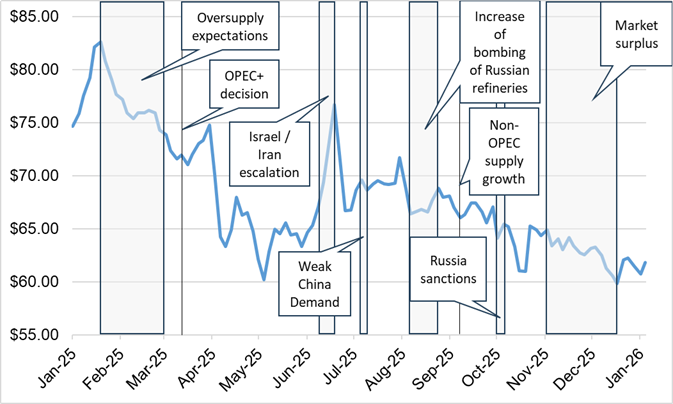
Figure 1: Brent Price Response to Market Events in 2025
Near-Term Outlook for Oil Prices
Looking ahead, the trajectory of oil prices will depend largely on whether the current geopolitical tensions translate into sustained supply disruptions. If the conflict escalates and significantly affects production or key transport routes such as the Strait of Hormuz, oil prices could remain elevated for an extended period.
However, if the conflict de-escalates and global supply flows remain intact, the geopolitical premium will likely fade. In that case, oil prices could return toward the $65–75 per barrel range, close to levels observed before the recent escalation. In the near term, therefore, the most likely scenario is that the current price spike represents a temporary geopolitical premium rather than a long-term shift in the global oil market.
See Also:
The Bottleneck for Venezuelan Oil Industry
References:
Bousso, Ron. “Oil prices and geopolitical risk.”, Jerusalem Post, December 2025, https://www.jpost.com/opinion/article-880994
Hoskinsand, Nick. Edser, Peter. “Oil and gas prices fall after Trump says war is ‘very complete’”, BBC, March 2026, https://www.bbc.com/news/articles/cx2jxe382pwo
“Oil Market Report – December 2025.”, IEA, December 2025, https://www.iea.org/reports/oil-market-report-december-2025
“Spot Prices.”, U.S. Energy Information Administration (EIA), https://www.eia.gov/dnav/pet/pet_pri_spt_s1_d.htm , Accepted March 9, 2026.
Ayaz, Humeyra. “US energy agency revises up Brent price forecast for 2025.”, Energy Terminal, July 2025, https://www.aa.com.tr/en/energy/oil/us-energy-agency-revises-up-brent-price-forecast-for-2025/50391
“Brent crude oil.”, Traiding Economics, https://tradingeconomics.com/commodity/brent-crude-oil Accepted March 9, 2026.
“Saudi Aramco sets Arab crude OSP for March.”, Argaam, February 2026, https://www.argaam.com/en/article/articledetail/id/1878124
Helme, Peeter. “Brent at $100, Urals at $91: the Iran war handed Moscow its best oil week in years.”, Euromaidan Press, March 2026, https://euromaidanpress.com/2026/03/09/iran-war-brent-urals-russia-oil-revenues/
“Oil Price Charts.”, OilPrice.com , https://oilprice.com/oil-price-charts/ Accepted March 9, 2026.
Disavino, Scott. “Oil prices up 8% on Iran war, pare gains after hitting highest since 2022.”, Reuters, March 2026, https://www.reuters.com/business/energy/us-oil-prices-jump-supply-fears-amid-expanding-us-israeli-war-with-iran-2026-03-08/
Tunagur, Enes. Kearney, Laila. “Oil prices log steepest annual drop since 2020.”, Reuters, December 2025, https://www.reuters.com/business/energy/oil-slips-brent-heads-longest-stretch-annual-losses-2025-2025-12-31/
Ghaddar, Ahmad. Astakhova, Olesya. Lawler, Alex. “OPEC+ to proceed with planned April oil output hike.”, Reuters, March 2025, https://www.reuters.com/business/energy/opec-proceed-with-planned-april-oil-output-hike-sources-say-2025-03-03/
Seba, Erwin. “Oil settles up 7% as Israel, Iran trade air strikes.”, Reuters, June 2025, https://www.reuters.com/world/china/oil-prices-jump-more-than-4-after-israel-strikes-iran-2025-06-13/
Disavino, Scott. “Oil prices dip to settle at 3-week low on US and China economic concerns.”, Reuters, July 2025, https://www.reuters.com/business/energy/oil-prices-dip-settle-3-week-low-us-china-economic-concerns-2025-07-25/
“Russian oil refineries, terminals burn as Ukraine hits Putin’s war economy.”, Reuters, August 2025, https://www.reuters.com/business/energy/russian-oil-refineries-terminals-burn-ukraine-hits-putins-war-economy-2025-08-25/
Anil, Anjana. “Oil price outlook steady as rising supply offset by concerns over Russian output: Reuters poll.”, Reuters, September 2025, https://www.reuters.com/business/energy/oil-price-outlook-steady-rising-supply-offset-by-concerns-over-russian-output-2025-09-30/
“The two Russian oil giants hit with US sanctions.”, Reuters, October 2025, https://www.reuters.com/business/energy/us-sanctioned-russian-oil-majors-rosneft-lukoil-2025-10-23/