

December 14, 2025
The Memorandum of Understanding between the Canadian federal government and the Province of Alberta, signed on November 27, 2025, mentions a new pipeline expected to bring Alberta’s bitumen to the northern coast of British Columbia. Such a project would face many obstacles. Incorrys believes that one of the critical challenges is the high cost of the project, particularly the risk of significant cost overruns.
Cost of Pipeline Construction
The most recent major pipeline project to move Alberta oil to customers is the Trans Mountain Expansion Project. The initial cost estimate, made in 2013, was CAD $5.4 billion. By late 2024, the total project cost had risen to CAD $34.2 billion. Several factors contributed to these cost overruns. External events, such as flooding in the BC Lower Mainland and the COVID-19 pandemic, accounted for about 25% of the increase. Engineering overruns represented approximately 55% of the added cost, construction practices above standard requirements accounted for 15%, and accommodation of stakeholders accounted for about 5%.
Engineering overruns were largely related to contractor management, as contractors were changed multiple times. The project also experienced significant technical challenges, including difficult terrain and unforeseen geotechnical conditions. Additional contributors to cost overruns included permit delays, requirements to accommodate Indigenous interests, higher debt-servicing costs due to schedule delays, and other project-specific factors.
Similar cost overruns occurred in the Coastal GasLink natural gas pipeline project, which transports gas from the Montney play in northeastern British Columbia to Kitimat on the BC coast. The original projected cost at the time of the project announcement (around 2018) was approximately CAD $6.2 billion. By November 2024, TC Energy estimated that the final cost would rise to CAD $14.5 billion.
A newly proposed pipeline from Alberta to the BC coast is expected to be roughly the same length as the Trans Mountain Expansion Project, which is approximately 1,150 kilometers. It would also traverse difficult terrain and cross mountain ranges. Would such a project experience similar cost overruns?
Delusion vs. Deception in Project Planning and Their Impact on Project Being Over Budget
Danish researcher Bent Flyvbjerg and his colleagues reviewed a large number of major infrastructure projects, primarily roads, railways, bridges, and tunnels. They found that, in many cases, project planners intentionally underestimate costs and overestimate benefits to secure project approval. Flyvbjerg reported that costs were underestimated in about 90% of the transportation projects studied. Based on data from 258 projects, the average cost overrun was 27.6%. Rail projects experienced the highest overruns (44.7%), followed by fixed-link projects such as bridges and tunnels (33%), and roads (20.4%). Notably, cost underestimation has persisted for over 70 years, despite advances in project management practices.
According to Flyvbjerg, planners often “cook” project plans and budgets by deliberately downplaying risks. A notable example is the Channel Tunnel between France and the UK, where actual costs were roughly double the original forecast because risks had a much greater impact than anticipated. In this case, risk assessments were intentionally flawed.
Another source of estimation error is optimism bias, also known as the planning fallacy. This refers to the unintentional tendency of project teams to be overly optimistic about schedules, budgets, and outcomes. Project managers often underestimate risks, exclude factors they view as outside the project scope, or discount low-probability events. Unlike deliberate cost underestimation, optimism bias is unintentional.
Balancing Delusion and Deception
The relationship between optimism bias and intentional underestimation was discussed by Daniel Kahneman, Dan Lovallo, and Bent Flyvbjerg in the Harvard Business Review. Kahneman and Lovallo argued that optimism bias is a major cause of inaccurate estimates and cost overruns. Flyvbjerg countered that optimism bias plays a larger role in smaller, low-pressure projects, while intentional deception dominates in large, politically sensitive projects. He labeled optimism bias as “delusion” and deliberate cost understatement as “deception,” arguing that the scale and frequency of errors strongly suggest deception as the primary factor in large projects.
Understanding the balance between delusion and deception is essential for addressing cost underestimation. Delusion tends to dominate in smaller projects, while deception is more prevalent in large ones. For example, cost errors in major projects may stem 70% from deception and 30% from delusion (Figure 1). Delusion can be mitigated through systematic planning, robust risk management, and strong project control processes. To counter deception, it is important to rely on empirical data from comparable projects and to conduct independent cost assessments by organizations not directly involved in the project.
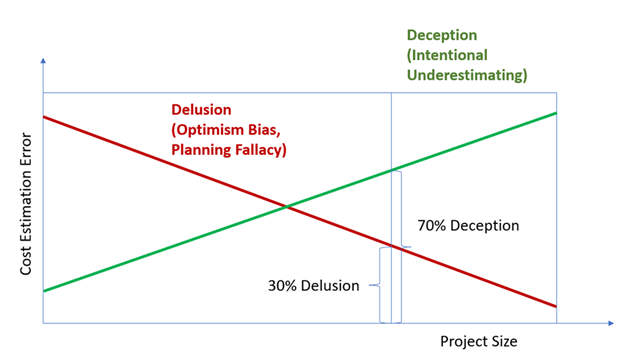
Figure 1. Delusion vs. Deception in Cost Estimation
Conclusions
It is possible to reduce the risk of cost overruns and estimate the cost of a construction project with reasonable accuracy, particularly by using actual data from similar projects.. However, the cost of the pipeline on the BC West Coast would still remain very large. To control the cost of the pipeline, it is important to mitigate managerial, legal, permitting, and technical risks. This can be achieved only through collaboration among all project stakeholders, including the project proponent, construction companies, all levels of government, First Nations, and local communities. Establishing such collaboration for a project costing over $10–$15 billion is a very difficult task. As a result, cost will remain one of the major obstacles to building this pipeline.
See Also:
Economic Benefits of a New Potential Oil Pipeline to Northern BC
US Emissions from Oil and Gas Industry: Current Trends
References:
“Trans Mountain Pipeline – 2024 Report.”, Office of the Parliamentary Budget Officer, November 8, 2024, https://distribution-a617274656661637473.pbo-dpb.ca/03a27244859717cd6e460f3bf5eb3612d9f3190b28f269c63a9bfb61aa7b23f7
“TC Energy provides Coastal GasLink Project update.”, TC Energy, February 1, 2023, https://www.tcenergy.com/announcements/2023/2023-02-01-tc-energy-provides-coastal-gaslink-project-update/
Flyvbjerg, M. S. Holm and B. Soren. “Underestimating Costs in Public Works Projects: Error or Lie?”, Journal of the American Planning Association, vol. 68, no. 3, pp. 279-95, 2002.
Virine and M. Trumper, Project Decisions: The Art and Science, Second Edition, Berrett-Koehler, 2019.
Virine and M. Trumper, ProjectThink: Why Good Managers Make Poor Project Choices, Routledge, 2013.
Shepperd, P. Carroll, J. Grace and M. Terry, “Exploring the Causes of Comparative Optimism,” Psychologica Belgica, vol. 42, pp. 65-98, 2002.
Kahneman and D. Lovallo, “Response to Bent Flyvbjerg,” Harvard Business Review, no. December, p. 122, 2003.
Flyvbjerg, “Delusions of Success: Comment on Dan Lovallo and Daniel Kahneman,” Harvard Business Review, no. December, pp. 121-22, 2003.
Palmer G. and Virine L, “Why Large Capital Projects Are Too Often Over Budget and What to Do About It?”. In Proceedings of AACE International 2023 Conference & Expo, Chicago, IL